








This article appeared in the February 2021 issue of Resource Recycling. Subscribe today for access to all print content.
We’ve all watched the phenomenon since the COVID-19 pandemic began: As daily routines are disrupted and restaurants focus on carryout orders, the volume of single-use food serviceware destined for landfills across the country continues to grow.
But takeout containers are just one example of how the pandemic has increased our consumption of throwaway items. COVID-19 has created great challenges for recycling and waste reduction, but it’s also highlighted why we urgently need to rethink how we design, use and dispose of items.
The U.S. has 5% of the world’s population but uses 30% of all resources and creates 30% of all waste, according to academic research cited by the Story of Stuff project. Even before COVID-19, each person in the U.S. was creating nearly twice as much waste as a person did in 1960. All that waste contributes to the climate crisis, as does the production of all the stuff we purchase.
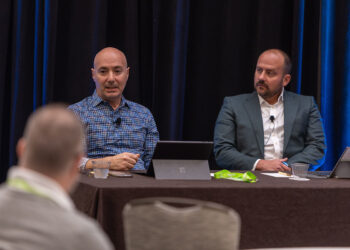
To better understand how to address our consumption woes, the Center for Biological Diversity, where I work, partnered with state recycling organizations in 2019 to conduct three focus groups around the topics of zero waste, extended producer responsibility and “conscious consumption.” These discussion groups were made up of mostly local and state government recycling professionals.

The Center for Biological Diversity is a national, nonprofit conservation organization that uses science, law, organizing and creative media to protect wildlife and the wild places they need to thrive. That includes seeking solutions for reducing the pressure our consumption of stuff puts on the environment.
Although the focus groups convened before the pandemic, they provide valuable insights into how we can move forward in a better way, even in this changed world.
Is ‘zero waste’ attainable?
The idea of zero waste has been around for decades, evolving from a waste management theory to a lifestyle movement to a mantra among certain product manufacturers. But when recycling experts sat down to talk about zero waste, they mostly focused on composting and recycling.
The group did talk briefly about reuse – examples noted in focus groups included purchasing a reusable growler from a local brewery or choosing to use reusable utensils, cups and dishware for a wedding – but there was no discussion about waste prevention within communities at large.
One of the biggest barriers identified by the attendees to embracing zero waste as a community-wide solution was that the terminology implied perfection and felt unattainable. So even though the concept has value, we need more accessible ways to talk about it, recycling industry professionals noted. Participants also identified that this solution can only succeed with both upstream and downstream help.
Upstream entities, however, will often deflect responsibility, claiming a product or package is created only because people want to buy it. This narrative puts all the responsibility on the individual instead of the producer.
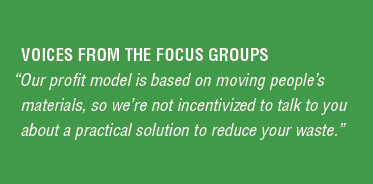
Those of us working in the waste reduction and prevention field need to collaborate with designers and engineers at upstream entities to design zero waste products and packaging. We should also work with governmental public health officials to clarify the rules associated with reusing personal containers at restaurants to make it easier for individuals and businesses to stop relying on single-use items.
Better understanding of repair realities
Moving into the field of policy, focus group participants said they were aware of extended producer responsibility, which places responsibility for end-of-life product management and design improvement on the producer. (See the Q&A on page 24 for more on how this concept is grabbing the attention of more U.S. industry stakeholders.)
But the recycling professionals we talked with were less aware of the practice of planned obsolescence and the recent push for Right to Repair laws.
Planned obsolescence describes the practices in which a company designs a product to be useless, undesirable or non-functional within a set period, forcing a customer to buy a similar – but new – product before they may have otherwise.
That issue is at the heart of a lawsuit alleging that Apple intentionally slowed down certain iPhones after the release of a new iPhone version. Apple has also come under fire for restricting the ability of third-party technicians to repair its products, forcing customers to buy new products instead. Such practices would result in corporate profits for producers while dumping the cost of premature disposal on recycling and waste management agencies.
One way to counter these corporate wrong-doings is to enact Right to Repair laws, which require manufacturers to share information that helps consumers repair the products they buy. While the focus group discussions made clear that more needs to be done to educate people about these issues, one recommended solution was to create a clearinghouse that would list companies that use planned obsolescence, those that allow for repair and/or those that offer product recycling take-back programs.
Conscious consumption carries complexities
After discussing how much responsibility for waste fell to producers, we shifted gears to discuss whether or not one person could make a difference by consuming in a more conscious manner.
The trend toward conscious consumption has at its core the understanding that some may need to consume less, some differently and others may actually need to consume more.
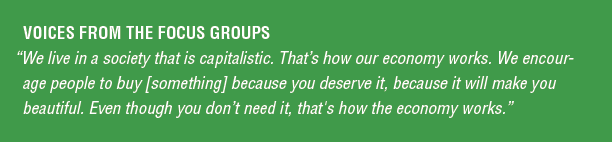
COVID-19 has changed the way people consume things. In some cases, single-use disposables have increased, but at the same time people are also cooking from home more and purchasing less of what they don’t really need. Our goal should be to reinforce and lock in these new sustainable lifestyle practices.
The focus groups wrestled with some big questions in this realm: Does your individual purchasing power matter? Do people have all the information they need to make informed purchasing decisions? Are purchasing decisions equitable across groups?
The issue was raised that individuals can only make a difference if they know what actions to take and if they’re able to take them. If you don’t know what product has the lowest environmental impact or is more easily recyclable, or if the preferred version is unavailable or unaffordable, it becomes much harder to make the best choices. Participants identified the need for transparency on the part of manufacturers to help individuals consume consciously.
But participants also noted that even with transparency, it’s not always easy for people to change how they consume. One person, for example, talked about how their mom would love to be a more conscious consumer, but when she goes to the grocery store after a hectic work day, “It is really hard to ponder upon the benefits of what you’re buying when something’s convenient and quick.”
The group recognized that until other larger societal issues like wealth inequality, lack of affordable childcare and poor public education are addressed, creating more equitable opportunities for all to consume consciously may prove difficult.
 The roles we play in the stream
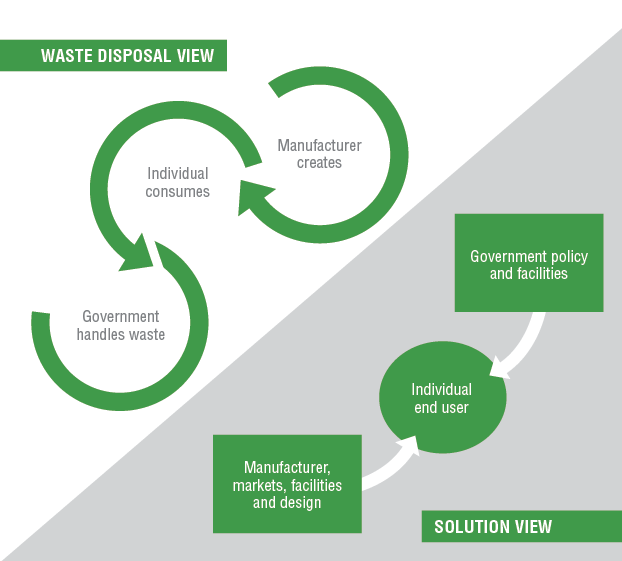
The groups also took part in conversation looking specifically at issues around upstream and downstream responsibility. Upstream entities were defined as manufacturers, organizations, corporations and institutions; downstream entities were defined as an individual or consumer.
The focus group participants acknowledged that not all upstream entities are equal. They talked about the alleged planned obsolescence of iPhones as an example of “really bad” corporate practice and offered counter examples, like Patagonia, which makes clothing and has a strong ethic of corporate accountability by repairing or replacing their products for free.
The group also talked extensively about “perceived” obsolescence on the part of the individual. An example here is a person who holds the “mind-set that you have to have the latest and greatest” even if the older product is still functional. Participants felt individual consumption rates were tied to entitlement (the “right to consume”) as well as age, culture, socioeconomic status and social norms.
The focus groups participants saw themselves as downstream actors handling waste after a manufacturer creates it and an individual consumes it. However, as participants in an institution, they are also upstream actors, like manufacturers, capable of creating change for individuals (see solution view in graphic above).
Consumerism, capitalism and the push to buy more
Based on discussions in previous focus groups, we also wanted to probe a little further on consumerism versus capitalism. In other words, is the problem that people feel they must consume increasingly more or is the issue more that we have an economic system driven toward endless growth?
In a previous focus group, the sentiment was that capitalism wasn’t the issue if it worked primarily to create products needed by individuals. But other participants believed that the manufacturers now tell us what we need and are marketing to us in a predatory way.
In the discussions with recycling professionals, participants didn’t point to either consumerism or capitalism as the prevailing problem, noting that both are issues deserving of focus.
While most participants agreed with the statement “A consumer holds the power over a manufacturer,” one participant differentiated between holding the purchasing power over which products are created versus the packaging that is used for the product. Since many attendees were local government recycling professionals, packaging was top of mind.
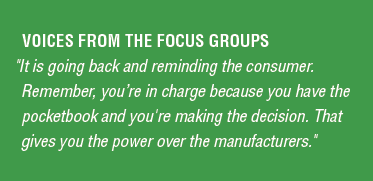
Participants also expressed frustration about residents calling to complain that they can no longer recycle certain plastics, since this decision is driven by trends in recycling markets, not local government decision-making. Some participants said they advise people to contact the companies that are making the product, noting that’s where the packaging problem starts.
Building people power
These focus groups showed us leaders in the industry are excited to talk about these broader issues and their potential solutions. Unfortunately, they also said they lack self-efficacy to instigate change in their organizations and in their personal lives.
But everyone in the recycling community can help overcome these challenges.
The responsibility for change needs to be shared between both upstream and downstream actors, along with those in the middle (for example, a vendor, retailer or distributor).
Manufacturers can help build back better after the pandemic by investing in new design considerations that optimize material use, reuse and recovery; supporting more local and regional supply chains; and looking at new business models that shift from material consumption to service utilization with closed material loops.
Recycling professionals, meanwhile, can support consuming consciously by promoting secondhand shopping along with durable and repairable products and encouraging friends, family and the community at large to think about what they really need and what will bring them happiness when shopping. They can also support borrowing, sharing and reuse infrastructure and third-party safe sanitizing refillable systems to create local jobs and supply chains.
As a society, we must ask companies for product transparency, which will enable us to leverage our individual and organizational purchasing power to make informed decisions. We can also support extended producer responsibility as well as Right to Repair laws and scorecards highlighting companies that plan for obsolescence. The end goal is to help the public be fully informed.
Finally, we must use our voices to advocate for laws making companies accountable for their products and packaging. One example is the Break Free from Plastic Pollution Prevention Act that was introduced to Congress last year.
By changing the way we produce and consume goods, we can begin to change the way we think about prosperity and well-being and protect the environment.
Kelley Dennings is a campaigner with the Center for Biological Diversity. She has worked for local and state government recycling departments as well as a national recycling nonprofit group, and and now focuses on waste reduction and reuse. Dennings can be contacted at kdennings@biologicaldiversity.org.
The author would like to thank the Nebraska Recycling Coalition and the Virginia Recycling Association for partnering with the Center for Biological Diversity to hold these focus groups and to all those who participated and shared their perspectives.